Welcome to Play Smart, a game-improvement column that drops every Monday, Wednesday, and Friday from Director of Game Improvement content Luke Kerr-Dineen to help you play smarter, better golf.
There’s no shot more alarmingly unpredictable than a mudball. A big, ugly clump of mud can transform what would’ve been a straightforward iron shot from the fairway into golf’s version of Russian roulette. But thanks to a recent study from Paul Wood, a PhD and Ping’s VP of engineering, golfers can get a measure of certainty when it comes to mudballs that we’ve never had before.
The article, which you can read in full on Ping’s website right here, highlights a recent study Ping conducted using its Ping Man Robot. They set it to swing a 4-iron at 95 mph, which corresponded to about 220 yards, and began hitting shots while caking mud on a variety of different locations on the golf ball: on the left side, the right side, on the back, front, all over and of course, nowhere.
What they found was wild, but surprisingly consistent for each location of mud. You can see the full results here, but a few interesting insights:


- The golf ball flies in the opposite direction of the mud. So, when the ball was on the left side of the golf ball, the ball flew to the right. When the mud was on the left, it flew to the right.
- The ball curved between 25 and 30 yards in the opposite direction of where the mud was.
- The ball flies shortest when the mud covers the entire golf ball, or is located on the bottom of the golf ball. That’s because when the mud is situated like this, the club hits the mud before the ball and therefore decreases “energy transfer.”
- When the mud is on the front of the golf ball, on the opposite side of where the club will impact the ball, that’s pretty much the best case scenario for a mudball, but it does mean the ball will fly a little shorter.
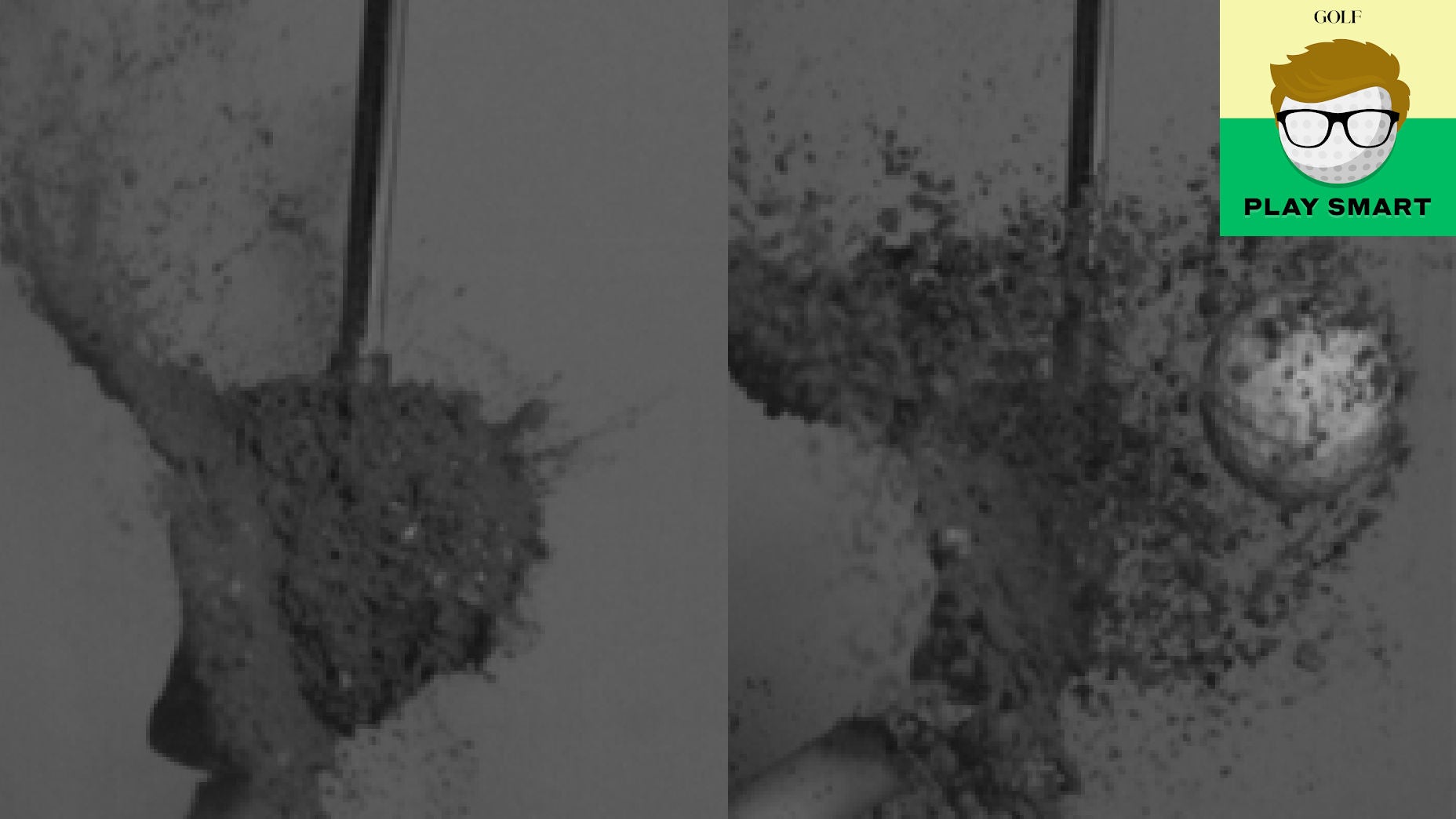
- No matter how much mud is on the golf ball, or where it’s located, the mud flies off milliseconds after impact, as you can see in this mind-bending picture below. That’s why the ball flies in the opposite direction.

All in all, Wood suggests some simple advice the next time you face a mudball situation: “Mud on your ball can lead to a loss of carry distance, depending on how much mud gets between the club and ball, so take an extra club, or two, if there is a lot of mud on the ball.”
Or, of course, you could just clean it off.