Welcome to Play Smart, a game-improvement column that drops every Monday, Wednesday, and Friday from Director of Game Improvement content Luke Kerr-Dineen to help you play smarter, better golf.
There are lots of unknowns in golf, which is a big part of what makes the game so intimidating and difficult. Playing golf on a course involves navigating a seemingly never-ending cascade of unknowns. But with golf season coming up, we’re trying to change that, so I tasked my colleague Andrew Tursky and our own DJ Lantz with a mission: Take a golf ball, an iron and a Foresight Quad, and measure the effects different lies have on your shots.
After overcoming the shock that Tursky can smash a 214 yard 6-iron with relative ease, the results of this Play Smart experiment were fun and, I think, informative. Keep them in mind the next time you go play…


View Product

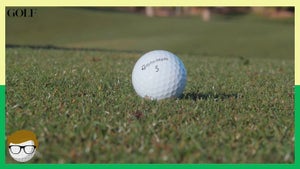
1. Fairway
First, we needed a baseline from the fairway. So Tursky hit a solid 6-iron from a perfect lie, which finished 214 yards with 5,145 RPMs of spin. Don’t worry, those numbers will make more sense later on.
The Lesson: When looking for your baseline number from the fairway, don’t base the number of your best shot, otherwise you’ll end up coming up short. Base your club’s number off an average shot.


2. Divot
Next, we had Tursky hit his ball out of a juicy divot. The best way to play this shot is to adjust your setup slightly to hit the ball first, and when Tursky did that, his distance dropped to 198 yards and his spin jumped to 6,000.
The Lesson: The ball will go higher and shorter from a divot, so take an extra club or two.

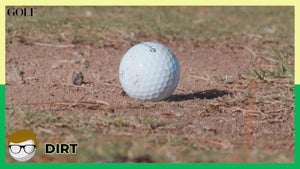
3. Dirt
Next up, Tursky hit a shot off hard dirt. He toed the shot slightly, but which made the ball fly a little shorter at 207 yards, but more significant was the spin rate dropping all the way down to 3,900 RPMs
The Lesson: The ball will go a little bit shorter from a deadpan lie, but it’ll roll more, so beware any trouble between you and the green.

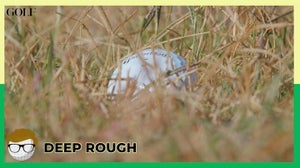
4. Deep Rough
We’ve all been in this unenviable position. Tursky’s distance from this position fell off a cliff to 162 yards, and the spin dropped to its lowest of the experiment: 3,150 RPMs. That happens when the ball hits high on the face, which robs it of all spin. It’s what pros often call a flier lie.
The Lesson: Lies like this are wildly unpredictable. It all comes down to making solid contact and judging the spin correctly. If in doubt, wedge it out.
Here are the full results from our experiment, and you can watch the full video either above or below:


Need help with your iron play? Start with a fitting from the experts at our sister company, True Spec Golf.