Welcome to Shaving Strokes, a new GOLF.com series in which we’re sharing improvements, learnings and takeaways from amateur golfers just like you — including some of the speed bumps and challenges they faced along the way.
While hitting balls at the driving range the other day, my first instinct was to obviously see the dispersion of each shot — which helps reveal my tendencies with different clubs.
But the next thing I looked at? My clubhead speed and subsequent distance, which allows me to get an idea of how far I’m hitting each ball while using each club in my bag.
Sure, it’s important to know my club’s carry distance, but why are we all so obsessed with swing speed and power?


There’s no doubt it has something to do with the many pro players who are capable of hitting driver over 300 yards, along with everyone believing more distance always translates to lower scores. (Note: It doesn’t.)
Regardless of the reason why you want more power and distance (vanity versus substance), it’s something we all strive for.
That doesn’t mean we’re always going about it the right way, though.
Unfortunately, most amateur golfers just think that swinging as hard as they can is the way to get more speed and length. But as one very smart person once told me when it comes to club speed, “if you don’t have the fundamentals for increased swing speed, your shots are going to show it.”
So what’s a good way to generate more power without going 1,000 miles per hour in your golf swing? According to GOLF Top 100 Teacher Jason Baile — the Director of Instruction at Jupiter Hills Club — it’s simply understanding how to use the ground to your advantage.
How to use the ground for increased power
In the video above, Baile talks about creating more force by using the ground, which, in effect, will help lead to a dynamic backswing position.
A dynamic position is when one part of the body travels in the opposite direction of another part of the body. So if the lower lower body starts forward while the arms and club are still going back, it creates a snapping motion in the club.
In this case, Baile uses both his trail and lead foot to create this motion, and uses a force pedal to demonstrate how it all acts together in unison.
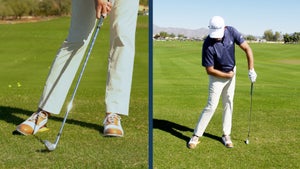
“I’m going to place [the force pedal] on the inside of my trail heel,” he says.
“I’m going to start with the pressure being a little bit here on the ball of my left foot [front foot for a right-handed player], and as I load up into the top of the backswing, that pressure’s going to work diagonally into my trail heel.”
As Baile does this, it allows his inside foot to push toward impact.
“So if we take it from the top from there, diagonally this way [on the backswing rotation], the glute gets deep, and push back in to a good impact position.”
Many amateur players often misuse their feet in the golf swing. But by concentrating on this tip from Baile, not only will you be able to use them the right way, but you’ll be able to generate more power, too.


