

Yoda once said that “to gain control, one must give up control.” In golf, the equivalent is, “to make putts, one must not try to make putts.”
Last year, a PGA Tour player came to me a week before the CJ Cup with a very, very cold putter. The first thing I did was have a conversation about the importance of the “Approach Putt Performance” — essentially a lag putting statistic that measures PGA Tour players’ average length of their second putt. The tour average is about 2 feet four inches; heading into the CJ Cup, this player was 213th out of 223 players in this metric, and fifth from last in SG: Putting.
My advice to improve his lag putting was simple: Stop trying to make putts, especially from 15 to 30 feet.

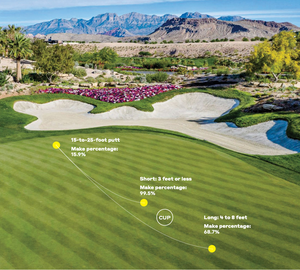
The truth is, you simply must be comfortable with leaving a relatively large percentage of putts short — about 25 percent — even on the seemingly makable putts from inside 10 to 20 feet. That’s what’s mathematically optimal.
Why? Because speed is king in putting, and the speed you hit your putts can have a huge impact on the width of your shot pattern. Think about it like this: If you hit a putt too firm or soft on your intended line, it may start breaking sooner or later than you wanted, but directionally, they will end up in similar spots. The big difference between those two fronts comes in back-to-front: One may end three feet short of the hole, another five feet long. Two putts with identical start lines will still become quite wide due to poor speed control, which directly impacts your overall make rate — and heaven forbid, your three-putt rate.
When players have poor putting rounds they almost always go to the green and work on their stroke when in fact their line was most likely good enough to hole putts if they had better speed control.
You can test your own speed control by hitting about 20 relatively straight putts on a practice green at a ball mark 20’ away. Measure the distance between your shortest and longest putts and the width between your furthest left and right putts. If you’re an average player, I’ll guarantee you that your shot pattern will be 3 to 6 times deeper than it is wide.
As for that Tour player? Keith Mitchell. At the 2021 CJ Cup at Vegas’ Summit Club, he adopted the mindset of not always trying to make putts from 10 to 20 feet. That week he left 25 percent of his putts from 15 to 26 feet short, finished 5th in Strokes Gained Putting and third in the tournament.
Scott Fawcett is the creator of the DECADE Course Management system and app.


