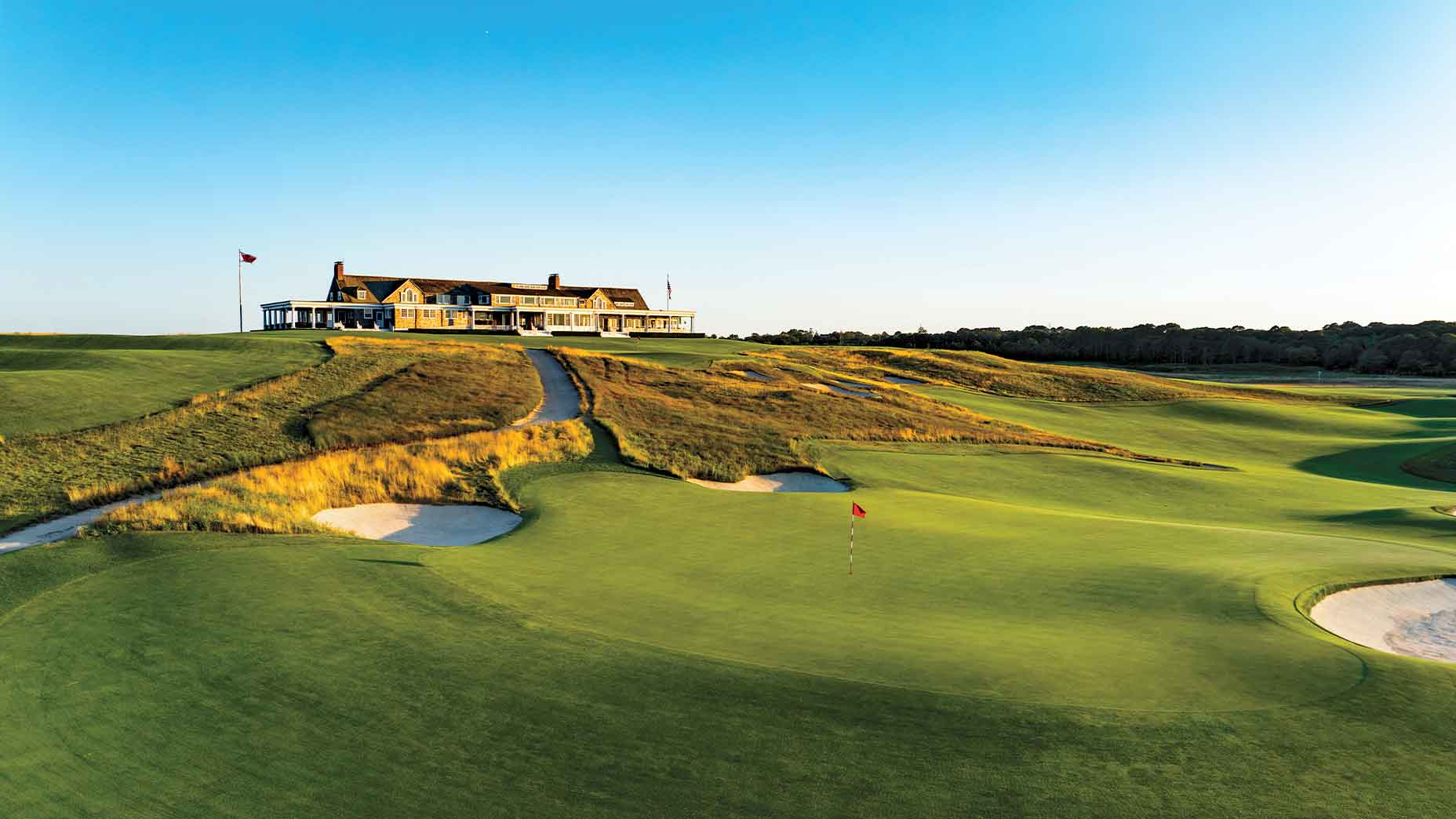
Shinnecock Hills, host of this year’s U.S. Open, draws you in with its stately clubhouse, high on a hill and oh so lovely. Then there’s the course, beastly and beautiful — a perfect exam for golf’s ultimate test. So, how have players handled this icon of New York golf? Some, not so well. (Here’s looking at you, Lefty.) Others have been in just the right state of mind.
As with other gorgeous creatures, you have to see Shinnecock Hills up close to fully appreciate her complexity. Up close, and over time. Gorgeous, yes, but moody like you wouldn’t believe! The great course has changed over the decades, as all living things do. But Shinnecock changes over any single day too — especially in the long days of early summer. She’s like the Old Course in that way, or Dornoch or Troon. Shinnecock Hills, on the sandy South Fork of Long Island, is our nod to the motherland. Some of the holes have Scottish names. (Ben Nevis, Redan.) But Native American names too: Peconic, Sebonac, Montauk and Shinnecock. How fitting. The course was built by Shinnecock men, using a template imported from Scotland.
There’s nobody left from the 1896 Open at Shinnecock Hills, but there are boatloads of us still around who were on hand for the return engagement, 90 years after the first. Jack Nicklaus, the reigning Masters champion, played his first round of the ’86 U.S. Open on a dank and wet afternoon. The Golden Bear holed out on nine, walked past the Stanford White clubhouse, then watched his tee shot on 10 sail over a wide swath of yellowish rough and toward a cluster of unkempt shrubs. For the first time as a pro, Nicklaus had lost a golf ball. He made the lonely walk back to the tee, driver in hand, looking like he had just buried his dog. Three days later, Ray Floyd, flinty old North Carolina pro and the son of one, hugged the Open trophy, his eyes narrow against the afternoon glare and moment. Father’s Day, 1986. Raymond was reborn, and so was the course.


The third Open at Shinnecock was in 1995. Let’s roll the tape on Corey Pavin on 18 on Sunday: driver; 4-wood; two-putt par on a green with more tilt than a pinball machine. After wrestling the course for four days, Pavin had shot 280, even par. Straight ball, air-attack golf doesn’t play at Shinnecock Hills. At least, it doesn’t win. Cheeky little Corey Pavin won by two.
For Shinnecock’s fourth Open, in 2004, the course was still under 7,000 yards but this time dying of thirst. Phil Mickelson had another agonizing second-place finish and Retief Goosen won. Fourteen years later (No. 5; 2018), Phil was still nursing a Shinnecock Hills/USGA hangover. You might recall that moment when he went berserk, turning his putter into a hockey stick and his ball into a puck. Brooks Koepka won, by a shot over Tommy Fleetwood. Tom Watson said Koepka was the real deal, a player with all the tools. Tom Watson. Not known for effusiveness. But Koepka did what he did at Shinnecock, and that made all the difference. Koepka will be 36 when the U.S. Open comes to Shinnecock Hills for the sixth time, come June. Thirty-somethings and U.S. Opens — there’s a long marriage there.
Shinnecock unspools logically across its rolling and treeless 260 acres, with shapely fairways that act as wind tunnels. From start to finish the course is…sound. Sound, demanding and unrelenting.
Watson won his lone U.S. Open at Pebble Beach (at 32) and you’re tempted to say that Pebble is to the West Coast what Shinnecock is to the East, but it’s not. There’s no crashing-surf excitement at Shinnecock Hills, and it’s the opposite of public. (The club’s roots are old-guard WASP, elitist, exclusionary.) Shinnecock’s three neighbors — National Golf Links, Southampton Golf Club, Sebonack Golf Club — are sprinkled with moments of quirk and funk. Shinnecock unspools logically across its rolling and treeless 260 acres, with shapely fairways that act as wind tunnels. From start to finish the course is … sound. Sound, demanding and unrelenting. Somehow, Tommy Fleetwood shot a Sunday 63 when Koepka won. That’s like shooting 60 at Augusta.
He was 27 then, 35 now, and he’ll be 45 when the Open returns to Shinnecock for rendezvous No. 7, in 2036. Raymond Floyd was 43 when he won 40 years ago. He bought a house in Southampton and joined the club, and you could see him, now and again, sliding from the car park to the clubhouse in snazzy loafers and metal-framed shades. The ’86 Open turned Floyd into a superstar. The 2018 Open, for Koepka, did the same.

That clubhouse, broadly similar to Muirfield’s in Scotland, sits on the top of Shinnecock’s highest hill. For visitors and members, for motorists driving by, the clubhouse is a beacon, a weathered landmark of the American game. With its sturdy white columns around its perimeter, and sentry flagpoles on its east side and west, the Shinnecock clubhouse makes a proud here-we-stand statement.
But let’s consider another orientation here, an unlikely one, from the back tee on the 4th hole, in an almost rural nook of the course, deep in its northernmost reach. If you could go high on a cherry picker from that tee and gaze south you’d see it all: the pale, heaving course; the handsome clubhouse; the east-west tracks of the Long Island Rail Road; gas stations and strip malls; modern mansions on old potato fields; ocean beaches; the dark wonder of the Atlantic.
Then, somewhere beyond the horizon and in your drifting mind, the old country itself, birthplace of all this imported, madcap gorgeousness. At Shinnecock, nothing was lost in transit. She’s got those potato-chip fairways, ball-eating shrubs, magic-carpet greens plus, at the Open, a drinking-vessel trophy waiting for the winner. Enter the golfers, from all corners of the world, every last one fueled and encouraged by the vague promise of ecstasy.