
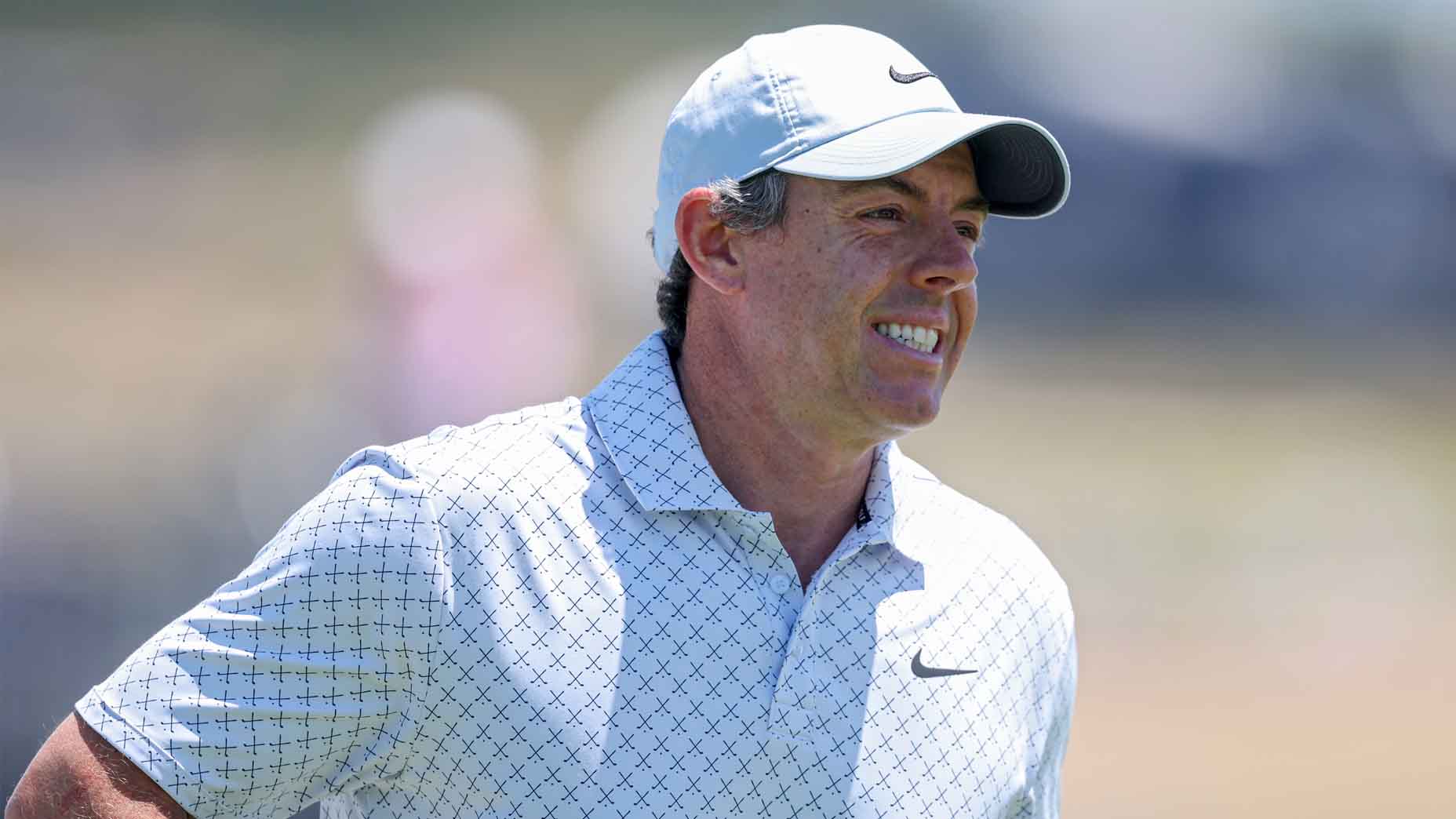
At 3:40 p.m. local time on Saturday, Rory McIlroy sent a shockwave through Shinnecock Hills. After missing the sixth green to the right, McIlroy pulled putter and rolled in a 66-foot bomb for birdie. Ten minutes later, he put another circle on his scorecard, his third in a row, and was firmly in the mix at this U.S. Open, sending the Long Island crowd into a frenzy.
McIlroy, who has said one of his remaining career goals is to win a U.S. Open on a U.S. Open course, bounced along Saturday with the trophy — and eventual winner Wyndham Clark — in his sights. It was all in front of him, the next box to tick on a legendary career resume.
Twenty hours later, Rory McIlroy was just trying to get out of Long Island as fast as possible.
“You try to come out here today positive and you try to muster up the energy to put a good one in there But a couple of bogeys on the front nine, I was just trying to race my way to the 18th green,” McIlroy said with a laugh on Sunday after finishing at six over for the tournament.
That’s how fast things can change at a U.S. Open at Shinnecock, especially when it starts playing like a U.S. Open.
McIlroy made the turn on Saturday at two under and just four shots back of Clark, who had opened with a bogey behind him. McIlroy had hung in the fight all week until that point. He had taken punches from the William Flynn design, wiped the blood from his brow and punched back. He had thrown away shots but also made several long-range birdies and given himself a chance with 27 holes to play.
The unraveling happened in a hurry.
McIlroy bombed his drive 365 yards down the par-4 10th fairway to the base of the green. But, just as he did in the second round, he airmailed a wedge over the back of the green and made bogey. Three-putt bogeys at 12 and 14 followed to drop him back to even par. Then, on the par-4 15th, McIlroy missed a two-foot par putt. Another bogey at 18 brought him home in 40 and put him nine shots back of Clark entering the final round. By the time McIlroy made it to the 18th green on Saturday, that patented bounce had long left his step. The energy he conjured on the front nine had either evaporated or been transferred to Scottie Scheffler, who was making a charge of his own. McIlroy rubbed his face and exhaled. A long, arduous battle with windy Shinnecock had left him exhausted and facing a U.S. Open Sunday with little on the line other than the faint hope of doing the impossible.
It had been there for the taking and disappeared before he even realized it had slipped away.
“I think it won the battle over me at this point,” McIlroy said on Sunday.
“I think looking back on the entire week, I’ll obviously rue the back nine yesterday. I got myself to two-under par for the tournament after nine yesterday, and then the wheels came off and played a really bad back nine. I sort of shot myself out of the tournament then. Obviously, I was really disappointed coming away from the course last night.”
The six-time major champion arrived Sunday hoping to mount an early charge when the wind was down — to do as Tommy Fleetwood did in 2018, post a number from the back of the pack and see if it’s good enough.
But the Rory roars he was hoping to conjure never materialized. He made a ho-hum par at the first and then missed a seven-foot putt for par at the second. Another bogey after a shaky approach at No. 3 put him 11 shots back of Clark and meant it was time for McIlroy to hang up his U.S. Open boxing gloves and make a speedy exit. He turned in four-over 39 and then, in the sort of cruel twist that golf loves to deliver, McIlroy found something that would have helped his U.S. Open cause — just a day late.
For the first time all week, McIlroy hit the proper approach into the 10th green and made birdie. He followed it with another birdie at 11. A day earlier, that would’ve put McIlroy at four under and right on Clark’s heels. A day later, it amounted to nothing more than a smattering of applause from the Long Island faithful.
“I could have done with that start to the back nine yesterday for sure,” McIlroy said.
Eight years ago, McIlroy left Shinnecock Hills on Friday after getting blown out to sea. It was then that he vowed to become a player more comfortable on hard, U.S. Open-style tracks rather than softer PGA Tour setups. In the years since, McIlroy has become one of the best U.S. Open players of the last decade. From 2019-2025, he had six straight top 10s and two runner-up finishes at the U.S. Open. When he poured in a 66-footer for birdie on Saturday, it felt like Rory McIlroy’s next U.S. Open moment might finally be arriving. His plan and patience had put him in a position to hunt down Clark and put the coveted Shinnecock pelt on his wall.
Then, Shinnecock delivered a haymaker, and McIlroy let go of the rope as the sun set along Peconic Bay on Saturday. By the time he had steadied himself, his U.S. Open dreams were in tatters, and all that was left was an 18-hole walk to nowhere at Shinnecock and questions about what might have been had he only been able to stay in the fight a little longer.


