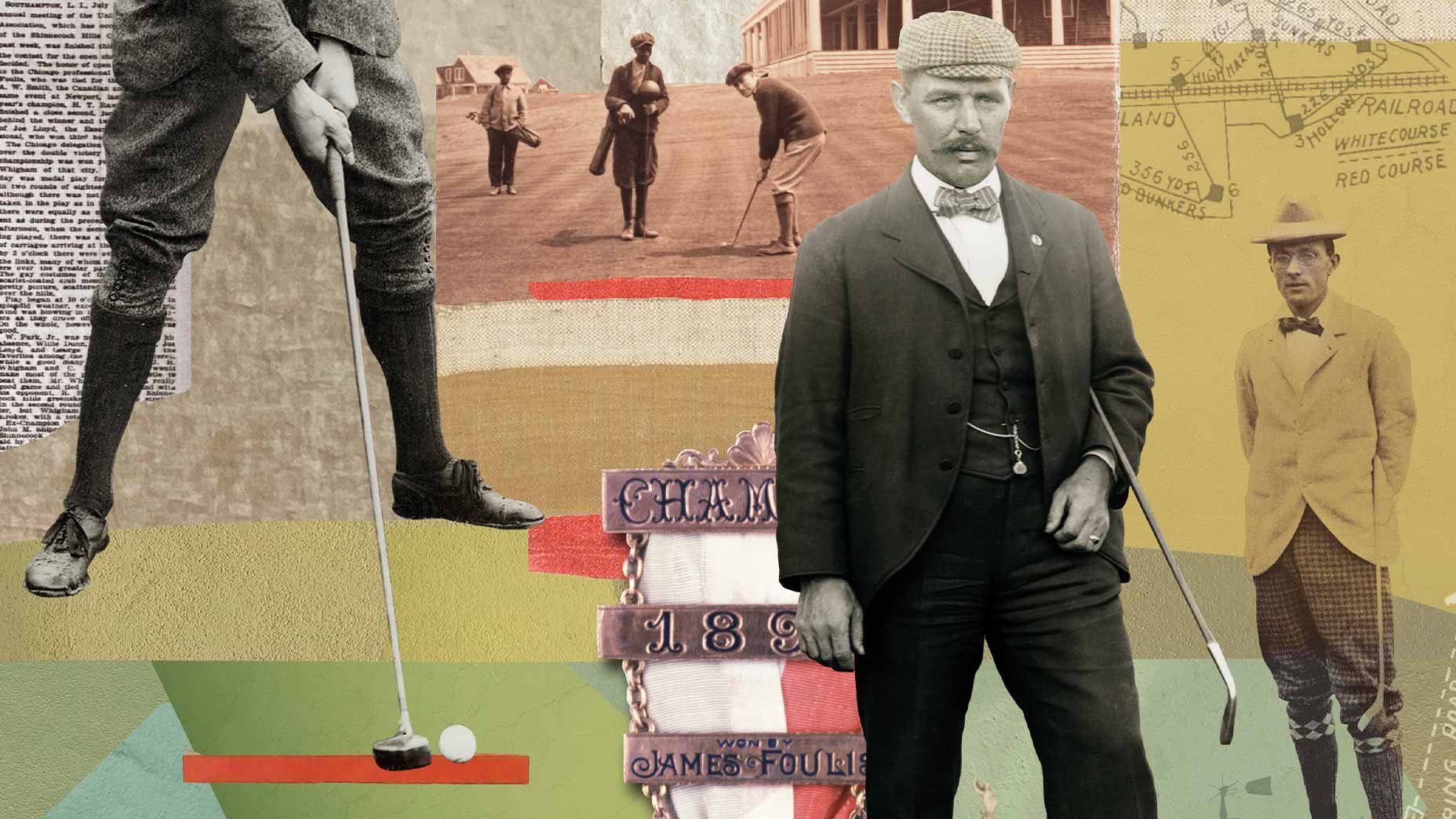
This content was first published in Golf Journal, a quarterly print publication exclusively for USGA Members. To be among the first to receive Golf Journal and to learn how you can ensure a strong future for the game, become a USGA Member today!
SOUTHAMPTON, N.Y. (July 18, 1896) – Golf is still in its infancy in the United States, but no one can deny that the game is developing into more than a curiosity. Courses are sprouting, and clubmakers are busy outfitting new players. With every new course laid out on these shores and every man or woman who is intrigued to take up this stick-and-ball pursuit, the Scottish game is becoming ours as well.
Further evidence of this growth was fully on display in the eastern reaches of Long Island. About 90 miles from New York City, there was great interest in the happenings at Shinnecock Hills Golf Club.
Not quite two years ago, Shinnecock Hills was one of the five clubs that joined forces to form a national governing body, the United States Golf Association. Having hosted the U.S. Amateur and this U.S. Open in those championships’ second year of existence, Shinnecock Hills is now part of the USGA’s nascent history in another important way.
The fields for both events were larger than a year ago, with nearly twice as many amateurs (58) and slightly more than triple the number of Open players (35). Some days, hundreds turned out to view the proceedings at Shinnecock Hills, which was recently expanded by Willie Dunn from 12 to 18 holes and a yardage of 4,423 yards.
The layout brims with challenge, from cop bunkers to ditches to railroad tracks. More than one golfer even had the frustration of finding out that a telegraph wire is of sufficient circumference to knock a gutta percha ball from its airborne journey. And with the Atlantic Ocean so close, the course can feature the winds of a British links, too, the kind that can perplex a player and stain a scorecard. It blew on the morning of the Open after overnight rain had given way to more summer sunshine, providing players one more thing to consider on a day already full of variables with a $150 sum (the same as in the Open a year ago) going to the winner.


The recent results were a reminder that Americans must not get ahead of themselves regarding their place in golf’s competitive pecking order. Golf was, after all, invented elsewhere, where there have long been frequenters of the green. The new champions, amateur H.J. Whigham and professional James Foulis Jr., hail from abroad – Whigham is an Englishman and Foulis a Scotsman, both now settled near Chicago, where their respective trophies will sparkle until next year.
Whigham, son-in-law of 1895 U.S. Amateur champion Charles Blair Macdonald, did not face much resistance in the final match. Thirty-six holes were scheduled, but Whigham required not nearly the full allotment to defeat Bostonian J.G. Thorp, 8 and 7. To rule in the Open – 36 holes of stroke play contested on July 18, after the amateurs had held the stage through medal qualifying and a 16-player bracket – Foulis lived in tighter quarters. The professional at Chicago Golf Club, Foulis finished two rounds only three shots clear of England native Horace Rawlins, the difference-maker being Foulis’ outstanding afternoon score of 74, the championship’s low round by two strokes. For Rawlins, who works at the Sadaquada Golf Club in Utica, N.Y., it was a spirited if unsuccessful defense of the U.S. Open title he secured last year at Newport Golf Club in Rhode Island, where Foulis tied for third place.
It likely will be a very long time, if ever, before golf sees the precociousness of youth as exemplified by the late Tom Morris Jr., who won the first of his four British Opens at 17, the last when he was 21. His genius was as bright and fleeting as a comet. Most men are a little older when they solve the championship puzzle. Harry Vardon, the man from the Channel Islands from whom much is expected, who grips the club in a distinct manner that distinguishes him before he begins his backswing, won his first British Open last month at age 26. That contest, at Muirfield, might well be remembered not only for Vardon’s ascent but perhaps the farewell of a true legend. Tom Morris Sr., the Grand Old Man of Golf, who was just short of his 75th birthday and competing in his 34th Open, didn’t tee off in the fourth round after failing to break 100 to that point.
Old Tom, a four-time champion, is a link to the very origins of an open competition, one of eight men who played in the first formal gathering in 1860, at Prestwick. The new American champion, 24, is no stranger to the colossus of the links and the Home of Golf. Foulis grew up in St. Andrews, his family home not half a mile from the Old Course’s first tee. He is one of five golfing sons of James Foulis Sr., the foreman at Tom Morris’ club-making concern in the “Auld Grey Toon.” The younger Jim, as he is known to many, picked up golf pointers not only from Old Tom but other talented locals such as Bob Martin, Sandy Herd and Andrew Kirkaldy.
With a valuable introduction from Old Tom, Foulis sailed with brother Dave to the U.S. 16 months ago to become the professional at Chicago Golf Club and is fully engaged in that early citadel of Western golf, passing along his knowledge to the exuberant members. Foulis has carried on despite a terrible fire at his workshop last fall, when thousands of dollars of equipment were lost to the blaze.
Mustachioed and standing five-and-a-half feet tall with a sturdy frame, Foulis is a man of moderation who indulges in the occasional cigar, but nothing about his golf is middle of the road. C.B. Macdonald gives no quarter around his new home, but Foulis has scant other opponents at his club who force him to his limits. His skill – especially the length of his drives – has turned heads and set records around Chicago. Foulis has recorded hits of more than 300 yards when the wind and turf were in his favor. Over the Shinnecock links, some of his shots finished more than 200 yards distant from the sand-formed tee from which they were struck. Less than a month before taking the long train ride to New York, Foulis was forced to halt his preparation for about a week when a hammer slipped as he was repairing his driving club, and he was left with a bad bruise on his left hand. But it healed sufficiently to allow him to get back in harness and caused him scant difficulty on Long Island.
Before any of the 35 U.S. Open competitors teed off in the first round, trouble simmered before being smothered. A contingent of professionals protested the presence in the field of a Black player, John Shippen Jr., and a Native American, Oscar Bunn of the Shinnecock tribe, pledging not to compete if the local teenagers – both caddies at the club – were allowed to play. Theodore Havemeyer, president of the USGA, rebutted, saying the championship would go on even if the two young men were the only competitors.


Members of the Shinnecock Nation were crucial to the construction of the golf course, which takes its name from the tribe. Bunn, who as an infant lost his father in a maritime disaster off Bridgehampton in 1876, grew up 2 miles south of the course. He took to the game and became proficient at it. He was not in his best form in the U.S. Open, shooting 89-85 to finish 21st, well away from Foulis’ winning total, but his presence and promise speak to the future of homegrowns in golf.
Shippen, the 16-year-old son of a Presbyterian minister who is cleric and teacher at the Shinnecock reservation, was an entirely different matter, strongly contending for the title. Shippen’s dedication and knack for golf have been clear to those in the Shinnecock vicinity for some time. Willie Dunn, now at Ardsley, north of New York City, took Shippen under his wing while at Shinnecock Hills, teaching him the ways of playing, club making and instructing others, to the point where he became the Scot’s assistant pro.
“He is extremely sound and devoid of eccentricity, and he is good at every point,” one observer wrote of Shippen prior to the U.S. Open. “He is a strong and sure driver, very clever in approach, and careful and skillful in putting.” That is fulfilling the whole recipe, and despite knowing some were displeased that he was playing, Shippen went out in the morning round in a pairing with Macdonald and recorded a 78, matching his best home score, which tied him for second place with Foulis, Dunn, Willie Tucker and Canadian amateur A.W. Smith, just two strokes behind Joe Lloyd. Members and his fellow caddies were round the 18th green when he finished to cheer his fine play.

Shippen was steady through the first stages of the second round too, strongly teasing the prospect of an American-born champion. That hope evaporated, though, on the 13th hole, not a particularly difficult two-shotter. Favoring the right side, Shippen hit his shot too far right, the ball finishing on a sandy road from which he had great difficulty escaping. He ended up with an 11, shot 81 and finished in a tie for sixth, seven strokes behind Foulis.
Many had been looking forward to watching professional Willie Park Jr., two times champion of The Open in his home country of Scotland (1887, 1889). Last year, the Musselburgh man had captured the fancy of those on this side of the Atlantic during a series of challenge matches, the Shinnecock links among his stops across the Northeast. Superb on the greens, Park lost but one encounter during his tour, complementing his peerless putting with remarkable power, including some of the longest drives yet struck in the brief history of golf in the United States. Shinnecock had been interested in hiring Park as its professional, but it could not be worked out.
Further heightening the keen anticipation among Americans of once again witnessing Park was the publication, just months ago, of “The Game of Golf,” the first book of instruction by a playing professional who had taken up the pen. And quite the primer it is, the volume fairly overflowing with Park’s specific and expert thoughts about a broad range of topics. One reviewer in his native land said Park “beats all his predecessors with as much ease as he had thrashed many an opponent on the links in his time.”
Park was immersed in golf from a young age; his father, Willie Sr., won the inaugural 1860 Open among his four titles and his uncle Mungo was champion in 1874. Willie Jr. has finished no better than joint fourth since his 1889 victory, and he tied 14th in last month’s Open at Muirfield, won by Vardon in a playoff over J.H. Taylor. Perhaps Taylor was fatigued following his long week at the championship, but Park nonetheless defeated him shortly thereafter in a 72-hole challenge for 100 GBP.
From pedigree alone, Park surely was expected to factor on Long Island. He was entered, and it was said he would be present by July 5. As the Shinnecock proceedings grew near with no sightings of the star, however, his presence seemed in doubt. Indeed, he didn’t arrive in New York City from Liverpool on the Cunard steamship RMS Umbria until shortly before 11 o’clock on Saturday evening, by which time all that remained of the second U.S. Open were toasts for the champion and regrets from those he vanquished.
Having missed out on the championship action here, Park will be eager to take on all comers in match play. No doubt he will be extremely eager to see what kind of purse can be on offer if James Foulis were to agree to a head-to-head contest. What a match that would be!

As the Umbria steamed toward the dock in lower Manhattan, too late for Willie Park’s purposes, the handsome Shinnecock Hills clubhouse, designed and expanded by Stanford White – who counts Madison Square Garden and the Washington Square Arch among his architectural achievements – was abuzz with satisfaction. The USGA was delighted with its host, the club earning a cup of its own from the governing body for the ways in which it greeted the golfers and those who watched them from the clubhouse veranda and its environs, set high on a bluff facing the ocean to welcome the sea breeze.
The men were center stage for these twin championships, but women have been a big part of things at Shinnecock Hills since its founding five years ago. Representing the club in the inaugural U.S. Women’s Amateur last fall, Mrs. Charles S. Brown (the former Lucy Barnes) claimed the trophy. Among those taking in the action last week was a young woman to keep an eye upon should she decide to test the competitive waters in this year’s ladies’ championship in three months. Beatrix Hoyt – whose mother, Janet, was an original Shinnecock Hills shareholder – just celebrated her 16th birthday. Like Shippen, who acquitted himself so admirably but for one tragic hole, she is ready to test herself.
There is talk that the 1897 U.S. Open might go to Chicago Golf Club, where Foulis would be a formidable defender indeed, but that is 900 miles and a year away. For now, thoughts are with the golf just played and an imported game on the bounce to bigger and better days.