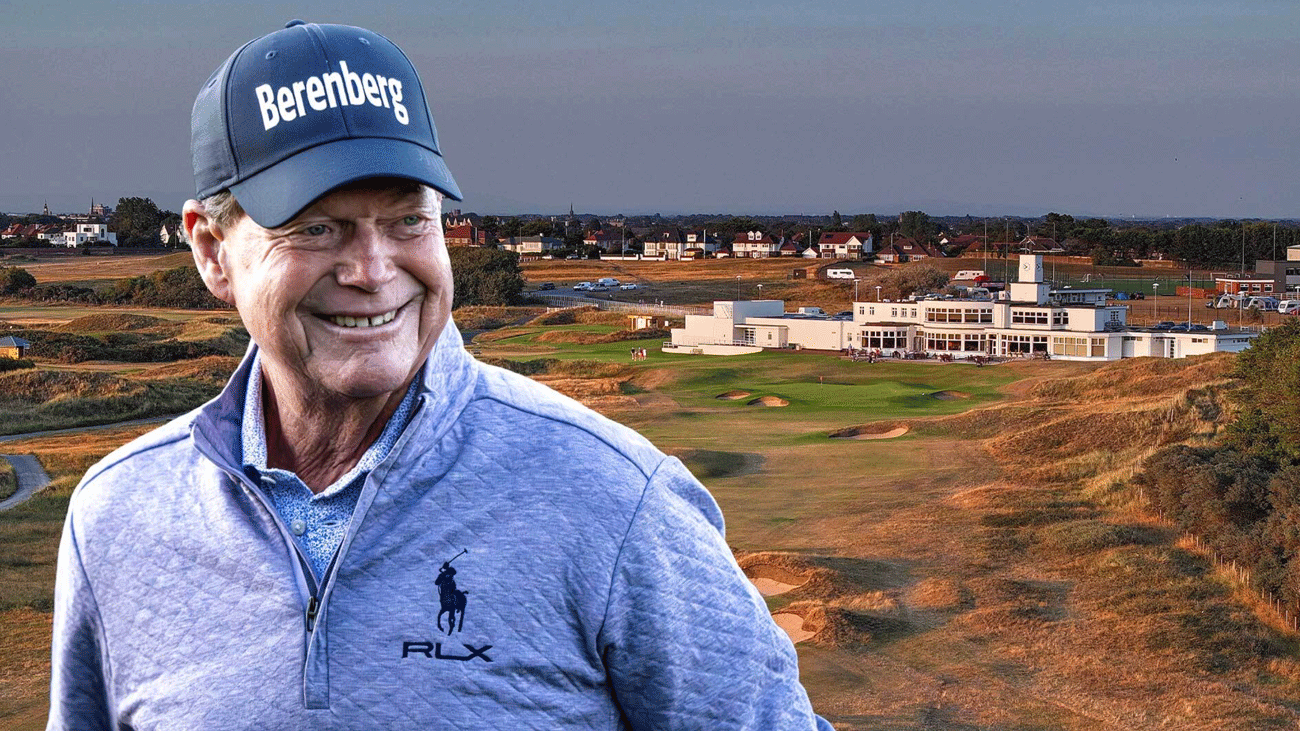
SOUTHPORT, England — It would not be a ridiculous overstatement to say that Tom Watson changed my life. When I was a teenager, in the 1970s, falling into this game, Watson was one of golf’s rising stars and also one of the game’s high priests. Usually, you are one or the other, but he was both.
I became enthralled by links golf watching Watson win the 1975 British Open at Carnoustie on TV. Now this is ridiculous: Watson’s first Open — he had never played in one previously — was my first Open; I had never watched one before. Watson won his fifth and last Open here at Birkdale in 1983. He almost won it again in 1984, at the Old Course. He almost won it again in 2009 at Turnberry. He was 59 and lost in a playoff. I was in the press tent when he came in and said, “This ain’t no funeral.” What a gift — four words on my way to 2,100, and a sense of balance, too.
WATCH OUR TOM WATSON INTERVIEW HERE:
When I asked Watson for an interview at the 1991 Open at Birkdale, he said sure. I came with a notebook, and we sat on a wooden bench in the men’s locker room. When I asked Watson for an interview at the 2026 Open at Birkdale, he said sure. I came with Darren Riehl, GOLF.com’s creative director/producer/camera operator, and the three of us sat in a bright room on the first floor of the clubhouse with a stunning view of the 18th hole. Watson talked about coming up 18 in good times (winning in ’83) and not-so-good times (missing the 54-hole cut as the defending champion in 1976). Back then, there was a 36-hole cut and a 54-hole cut.
(This is theory, not fact: The Open used to conclude on a Saturday. There were a lot of British club pros in the field. The 54-hole cut on Friday gave more of these pros a chance to get to their home clubs and report for duty on Saturday.)
Watson won all five of his Open championships with Alfie Fyles as his caddie. Fyles was, as Watson noted in the interview we did Thursday morning, “a Southport man.”
This part about Fyles’s life and times I had never known before, until Watson told it in our Thursday-morning interview. Alfie Fyles (not to be confused with his caddie brother, Albert) worked for Gary Player when Player won the 1974 British Open at Royal Lytham. But in ’75, at Carnoustie, Player decided to bring over his American caddie, Alfred Dyer, who went by “Rabbit.” The bosses at IMG, the marketing agency that represented Player, suggested to Watson that he hire Fyles for the week at Carnoustie. He did, they won, and, in ’76, Watson pulled a Player: He brought in his American caddie, Bruce Edwards, for the Open at Birkdale, even though Watson was 1 for 1 with Fyles, and even though Birkdale was Fyles’s home course. Different times. Now the caddies are indispensable members of “the team.” Until they are deemed dispensable.
Watson returns to Opens on a regular basis in part because he represents Rolex, and Rolex is a sponsor of the Open. But the biggest reason he returns to Opens — he played in his last one in 2015 at the Old Course — is because his play in Opens over the course of 38 years is a central part of his life experience. This year, he came with his wife, Dorothy. On their way here they went to Geneva and toured the Rolex headquarters there, and went to Wimbledon and watched the men’s and women’s finals. Hey, if you win five Opens, you might get similar invitations. In the meantime, learn the bump-and-run.
“This course is no different now than it was in 1976,” Watson said Thursday morning, with play underway. “These players have to play a very hard-running course. It’s really not any different, except for the length of the golf course. And they did redesign some of the holes here, so there’s a difference there. But overall, it’s really not any different.”
And neither, really, is Watson. Watson had a friend named Sandy Tatum who liked to say of Watson, “He has a swing that will not quit.” The Watson who pulled me into golf is, by and large, the same man Darren and I saw in the clubhouse Thursday morning. He’s straight, direct, efficient.
When Darren played at Augusta National one year, on the Monday after the tournament, he was given a locker in the locker room for former champions. Watson shares that locker, to this day, with Claude Harmon, father of six including the teacher Butch Harmon. Claude Harmon died in 1989. His nameplate remains.
“That’s amazing,” I said.
“No, it’s not,” Watson said.
You know what that means?
It’s not.
Michael Bamberger welcomes your comments at Michael.Bamberger@Golf.com. For much more from Watson, watch the video above.