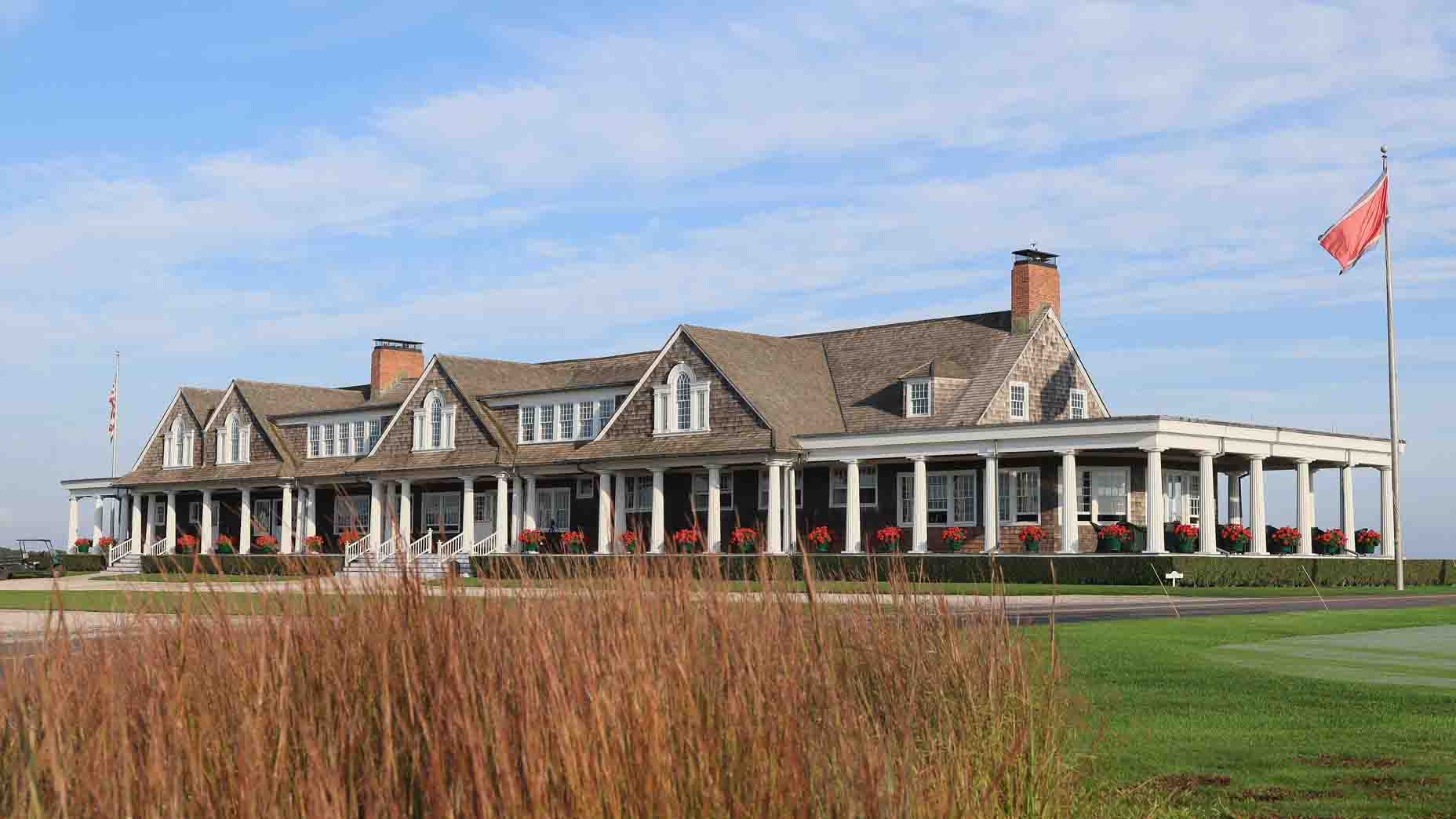
What Augusta National is to the Masters and the Old Course at St. Andrews is to the Open Championship, Shinnecock Hills Golf Club is to the U.S. Open.
Shinnecock Hills, the exclusive course on Long Island, is one of the five charter clubs of the United States Golf Association and, while it hasn’t hosted the most U.S. Opens in history (that distinction belongs to Oakmont), Shinnecock Hills is regarded by many as the best U.S. Open venue.
That fact can be debated, but there’s no question that the William Flynn masterpiece that sits between the Atlantic Ocean and Peconic Bay is one of the crown jewels of American golf.
It has hosted nine USGA events, including five U.S. Opens, and will host its sixth U.S. Open and 10th USGA event this week when the world’s best descend on Long Island for the 2026 U.S. Open.
Here are a few things you might not have known about this week’s famous U.S. Open site.
Five things you might not have known about Shinnecock Hills
U.S. Open history
Shinnecock Hills is the only course in history to host a U.S. Open in three different centuries. The winners at Shinnecock so far are:
1896: James Foulis (152)
1986: Raymond Floyd (279)
1995: Corey Pavin (280)
2004: Retief Goosen (276)
2018: Brooks Koepka (281)
After hosting the second-ever U.S. Open in 1896, Shinnecock Hills did not host another major for 90 years, although it did host the 1977 Walker Cup. But it will have now hosted four in 31 years after this week. In the last four U.S. Opens at Shinnecock Hills, only three players have finished the tournament under par. Raymond Floyd and Retief Goosen took home the trophy, while Phil Mickelson lost to Goosen by two shots. When Floyd won the 1986 title at Shinnecock, he became the oldest U.S. Open champion in history at 43 years, nine months and 11 days. That mark stood until Hale Irwin won the 1990 U.S. Open at 45.
During the 1896 U.S. Open, William Dunn, one of the original designers of Shinnecock Hills, led after the first round, but Foulis shot a 74 in the second round, which was played on the same day, to take home the title. Foulis shot a two-round score of 152 in 1896. Over 100 years later, that mark was better than the two-day number posted by Adam Scott, Sergio Garcia, Shane Lowry, Jon Rahm and Keegan Bradley in 2018, all of whom missed the cut.
A small U.S. Open prize
Foulis’ win in 1896 didn’t come with a Brinks truck full of money. When Koepka survived Shinnecock Hills in 2018, he took home $2.16 million. But in 1896, Foulis’ prize was $200, which adjusted for inflation is just short of $8,000 in 2026. According to the New York Times, the president of Shinnecock Hills also received a $200 gift from the USGA that week.
Inclusive Shinnecock
Golf doesn’t have an inclusive and progressive history, but Shinnecock Hills is different.
Shinnecock Hills was the first American course to admit women and did so from the moment it opened its doors. The club opened a nine-hole ladies’ course in 1893, and Shinnecock member Lucy Barnes Brown won the inaugural U.S. Women’s Amateur in 1895.
The 1896 U.S. Open, which Foulis won, gave Shinnecock Hills an early opportunity to highlight its inclusivity. Before the tournament even started, a group of international players protested the presence of a Black player, John Shippen Jr., and a Native American, Oscar Bunn. Those players pledged not to play if Shippen and Bunn were allowed in the field, but USGA president Theodore Havemeyer shut down the protest, saying that the tournament would go on even if Shippen and Bunn were the only two players in the field. Shippen, a teenager who lived on the nearby Shinnecock Native American reservation, had his entrance fees paid for by several members who had seen his skills. He wound up finishing in a tie for fifth.
Some architectural confusion that has been cleared up
Shinnecock Hills’ beginnings are somewhat muddled by inconsistent historical record-keeping and competing narratives.
A group of New York businessmen commissioned William Dunn and William Davis to design and build a course on the 80 acres of land they had purchased. The initial 12-hole course was hand-built over Native American burial grounds in the 1890s. Whether Davis or Dunn built that original 12-hole course has been a source of confusion over time. Dunn claimed in a 1934 article in Golf Illustrated that he had crafted the original layout. That account was later backed up in account by Samuel Parrish, one of the founders of the club. However, Parrish’s account was written some 30 years after Shinnecock was built and appeared to conflate Dunn and Davis at points. In John Kerr’s The Golf Book of East Lothian, published in 1896, he states that Dunn left England to become the pro at Shinnecock in 1893, two years after the initial track was built on Long Island.
In the 1981 book The Golf Course by Geoffrey Cornish and golf course historian Ron Whitten, William Dunn is credited with the initial design. But in 2004, Whitten wrote a piece for Golf Digest in which he corrected the record, noting that William Davis created the initial 12-hole design in 1891 and that Dunn made it 18 holes when he arrived in 1895. This is the official history now put forth by the golf club.
The course was then remodeled around 1916 by Seth Raynor and C.B. Macdonald. William Flynn redesigned the course in 1931 into what it is known as today.
A famous clubhouse with a dark story
Shinnecock’s clubhouse is the oldest in the country. It was designed by famed architect Stanford White, who also designed the Washington Square Arch and the second Madison Square Garden. It was in that version of Madison Square Garden (the NBA champion Knicks play in the fourth version) where White was shot and killed by Harry Thaw, a man whose wife White had sexually assaulted years earlier.
This led to what was called “The Trial of the Century,” in which Thaw was found not guilty on the grounds of insanity.